
Technology
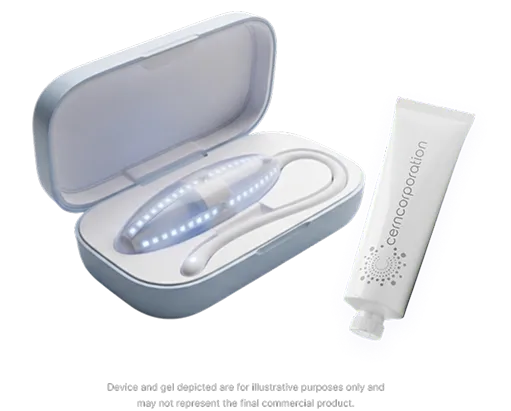
The Cern Device
- A reusable, precision-engineered intravaginal light-emitting device
- A proprietary, natural photosensitizing lubricant that enhances microbicidal activity
- A prescriptive treatment which is designed for home use
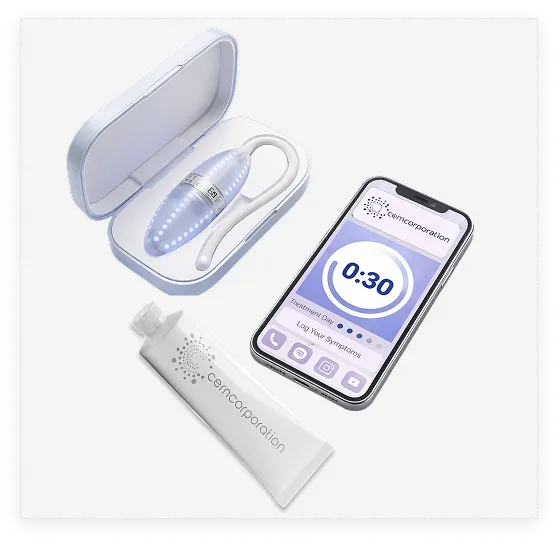
A precision-engineered, three-part system.
01 — The Device
Light-Emitting Device
A reusable, precision-engineered intravaginal device that emits controlled, visible-spectrum microbicidal light.
02 — The Gel
Photosensitizing Lubricant
03 — The Protocol
Designed for Home Use
A prescriptive treatment designed for home use, applied similarly to a tampon, as needed, when needed based familiar symptoms.

Proprietary Gel
The photosensitizing gel that powers the light.
The gel contains a proprietary, naturally derived photosensitizer and functions as a lubricant to facilitate device insertion and improve treatment delivery. It enhances the efficiency of the light-based treatment, helping to reduce required treatment duration.
The gel does not possess independent antimicrobial activity and is not intended to alter or disrupt the vaginal microbiome. The antimicrobial effect is driven by the device’s controlled, low-level, visible-spectrum light at the site of infection.
Dual-Pathogen Focus
One device. Two of the most common vaginal infections.
The CernDevice™ is being developed to address vulvovaginal candidiasis (yeast) and bacterial vaginosis (BV)—two common conditions that frequently coexist but are typically treated separately with antifungal and antibiotic drugs. Cern’s localized, device-based therapy is uniquely positioned to address both fungal and bacterial pathogens through a single treatment modality, offering a differentiated, non-drug approach for women experiencing yeast and/or bacterial infections, including those that may be recurrent.

Yeast (Candida)
Recurrent vulvovaginal candidiasis,
including drug-resistant Candida strains
conventional antifungals struggle to treat.

Bacterial Vaginosis
Mechanism of Action
From dysbiosis to symbiosis.
- Targeted Microbicidal Light
Controlled visible-spectrum light is applied directly at the site of infection, where it interacts with harmful microbes to initiate a localized antimicrobial effect.
- ROS Generation & Microbial Disruption
ROS effects susceptible microbes, inhibiting their ability to replicate.
- Targeted Cell Death. Symbiosis Restored.
Pathogenic Yeast
(e.g., Candida spp.)
Pathogenic Bacteria
(e.g., Gardnerella spp.)
Beneficial Lactobacillus
(e.g., L. crispatus)
ROS
(Reactive OxygenSpecies)
Why Visible-Spectrum Light Matters
Not All Light Is the Same.
Light-based medical applications span a wide range of wavelengths and wavelength selection is not a minor detail. It determines safety profile, tissue interaction, microbicidal specificity, and clinical suitability.
Cern’s platform uses precisely calibrated visible-spectrum light. Which is neither UV nor near UV. Here is why that matters:

Safety Profile
Visible-Spectrum Blue Light

UV Differentiation
Not UV-Based

Mechanism Difference
Distinct from Red-LightTherapy

Microbicidal Action
Targeted ROS-Mediated Activity
Cern’s visible-spectrum approach is fundamentally different from UV or “near” UV violet/purple and red-light systems by wavelength, mechanism, and intended clinical application.
Resistance Advantage
Evolving drug resistantmicrobes
These are significant concerns, and they are exactly what Cern is built to address
Conventional therapies target single biochemical pathways, which pathogens can evolve. Cern’s ROS-mediated mechanism operates differently: it attacks multiple cellular structures simultaneously, overwhelming the cell’s repair systems and eliminating the opportunity for resistance to develop. Preclinical data confirm efficacy against all named drug-resistant strains above.
Drug-resistant vaginal pathogens are a growing and underrecognized clinical problem. Species including Candida glabrata, Candida krusei, and fluconazole-resistant Candida albicans are on the rise — strains that current antifungals cannot reliably treat. The rise of antibiotic and antifungal resistant microbes is one of the most pressing concerns in infectious disease today.
- Multi-target oxidative mechanism
- No single pathway for pathogens to evade
- Efficacy confirmed against resistant strains
The Microbiome
Dysbiosis to Symbiosis
A healthy vaginal microbiome is a complex ecosystem of naturally occurring yeasts and bacteria that coexist in balance—a state known as symbiosis. When this balance is disrupted, Dysbiosis can occur, allowing certain native or introduced microorganisms to become disproportionately abundant and potentially contribute to infection.
Preclinical in vitro data demonstrate preservation of Lactobacillus crispatus alongside significant pathogen reduction. This selective profile, targeting pathogens while supporting the native flora essential to symbiosis is a differentiated outcome no current drug-based therapy can match.
Clinical Status
In development. On pathway.
- Currently under IRB-approved human clinical evaluation
- Classified as Non-Significant Risk (NSR)
- Advancing under an anticipated Class II De Novo regulatory pathway